

Written by Stefan van der Berg
In the West, we are obsessed with the "Deal." Whether it is the recent diplomatic theater surrounding President Trump’s attempts at an Iran peace agreement or the high-level negotiations in Oman, the Western worldview remains stubbornly transactional. We bring calculators to a region that operates on covenants; we offer spreadsheets to a culture that lives by the sword and the shield of Honor.
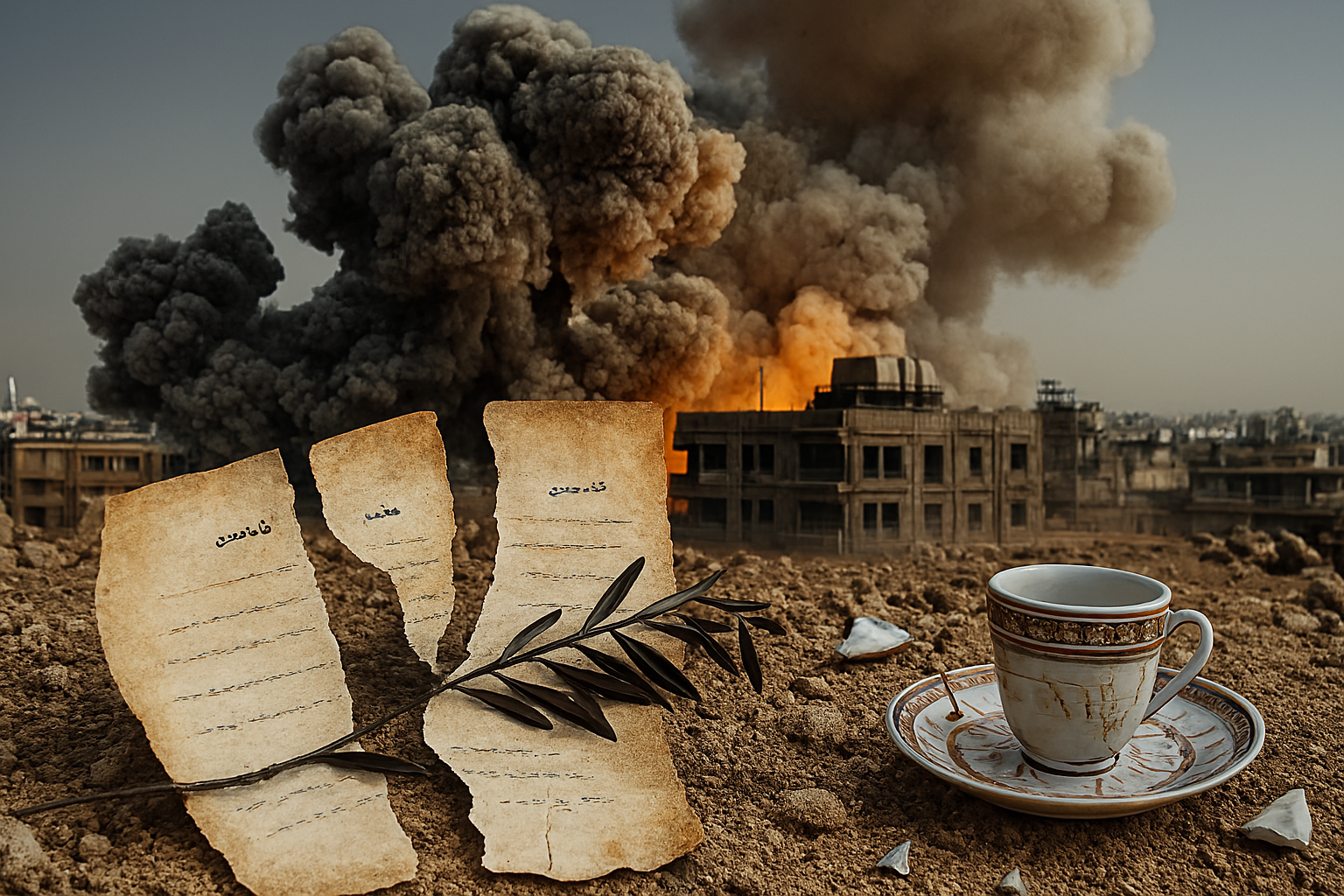
I did not learn this from a textbook or a briefing in a sterile embassy. I learned it through the steam of endless cups of Arabic coffee in the Beqaa Valley, over the breaking of bread in the shadow of the West Bank’s olive trees, and in numerous refugee dwellings where people have shared their last meal with me. They did so not because of my credentials or my "plan" for their future, but because of my shared presence—a willingness to sit in the dust and listen to the lenses through which they view the world.
To truly understand why stability remains a diplomatic fiction in 2026, we must stop looking through the lens of Washington or Brussels. We need to put on "Middle Eastern glasses." As an Afrikaner who lived through the death of Apartheid and the birth of a fragile democracy, I’ve realized that peace is never found in the fine print of a contract. It is found in the restoration of dignity.
The Western Blind Spot: Transaction vs. Transformation
The current Western peacekeeping narrative treats the Middle East like a real estate dispute. The logic is simple: if we provide enough economic incentives or threaten enough military "fire and fury," the parties will concede.
But one has to ask: where are the Western advisors and the so-called experts of the region in these rooms? Is their nuanced understanding being leveraged, or is their input largely ignored and bullied into oblivion by a political machinery that demands a quick win? When diplomacy becomes a performance for a domestic base, the quiet, complex truth of the region is the first casualty.
The families who have hosted me in the Beqaa and beyond have shown me a reality that no political bullying can erase. To them, a "concession" is often synonymous with Shame ('Ayb). When a regional power enters a deal under duress, they aren't seeking peace; they are seeking a Hudna—a tactical pause to regroup and wait for the wind to shift. Westerners see a signed paper as the end of a conflict; Middle Easterners often see it as a temporary survival strategy. When we force a "deal" without addressing the underlying shame, we aren't building a foundation—we are just pausing the clock.
The Afrikaner Mirror: Security is a False Idol
I grew up in a South Africa that worshipped at the altar of security. We built walls, literal and metaphorical, believing that "order" was the same thing as "peace." I see that same "Lager" mentality today in the Middle East.
For the Afrikaner of the 1980s, the fear wasn't just losing power—it was the fear of being "shamed," of being driven into the sea, of losing our identity. In the refugee tents and the living rooms of the Middle East, I see that same paralyzing fear. We thought our "security" came from our strength, but we were merely prisoners of our own defense budgets.
What Mandela Knew: The Power of Restorative Honor
The world celebrates Nelson Mandela for his "forgiveness," but they often miss his most profound strategic insight: He protected the honor of his enemy. Mandela understood a truth that escapes modern Western diplomats: A humiliated enemy is a permanent enemy.
In the Middle Eastern context, this is the concept of Karameh (Dignity). Mandela didn’t seek to "crush" the Afrikaner; he sought to invite us into a new identity where our honor wasn't tied to the oppression of others. If we applied a "Mandela Lens" to current conflicts, the goal wouldn't be a "Grand Bargain" that declares a winner and a loser. It would be a "Face-Saving Exit" that allows all parties to retain their dignity. In a culture of Honor and Shame, you cannot have peace until the "Other" feels seen, not just silenced.
The "Living Stones" and the Theology of the Cross
Beneath the high-stakes optics of Foreign Ministers lies the only community that truly understands this "High Honor" alternative: the indigenous Christians of the Middle East.
For these "Living Stones"—the Church in Syria, Iraq, and the West Bank—peace isn't a political "victory." They have survived for two millennia not by winning wars, but by outloving their neighbors. They practice a Theology of the Cross, which is the ultimate rejection of the retaliatory cycle.
In a region where "Honor" demands an eye for an eye, the local Church offers a "High Honor" alternative: Radical Non-Retaliation. Forgiveness here is not a sign of weakness; it is the most honorable act imaginable. It is the willingness to absorb the blow so the cycle of vengeance stops. This is the exact spirit that allowed South Africa to step back from the abyss in 1994.
From Deal-Making to Covenant-Building
The "Oman Illusion" and the Trumpian "Deals" will continue to fail as long as they treat the Middle East as a museum or a prophetic chessboard. Peace will remain elusive until we realize that the currency of this land is not the Dollar, but Dignity.
We do not need more "peacekeepers" who bring more guns to enforce a "deal." We need "peacemakers" who, like the local Church and like Mandela, understand that the only way to break a cycle of shame is through a covenant of shared humanity. As we learned in South Africa, the "miracle" didn't happen because we agreed on the math—it happened because we finally stopped looking at the map and started looking at each other's faces.